 Skip to content
Why Understanding Cement Trailer Specs
Some customers have told me that when they purchase bulk cement tank trailers from China, they can’t understand the suppliers’ specifications and don’t know what each parameter represents. Sometimes, they find all Chinese suppliers’ specifications identical and finally have to choose only based on the price.
Product specifications are very important. If you can’t understand the specifications, selecting a suitable product and a reliable supplier will be difficult.
Today, to aid you in selecting and using bulk cement tank trailers, I’ve carefully prepared this guide, ‘Master Your Cement Tank Trailer: Specification Guide’, to help you easily understand and master the knowledge of cement powder cement trailers’ specifications. This guide should help inform your purchasing and usage decisions.
Types of Bulk Cement Tank Trailers
Generally, the structure of the tank body is divided into V-type cement tanks and W-type cement tanks.
The V-type cement tank can only be used to transport cement and fly ash, and it uses compressed air to unload the cement powder.
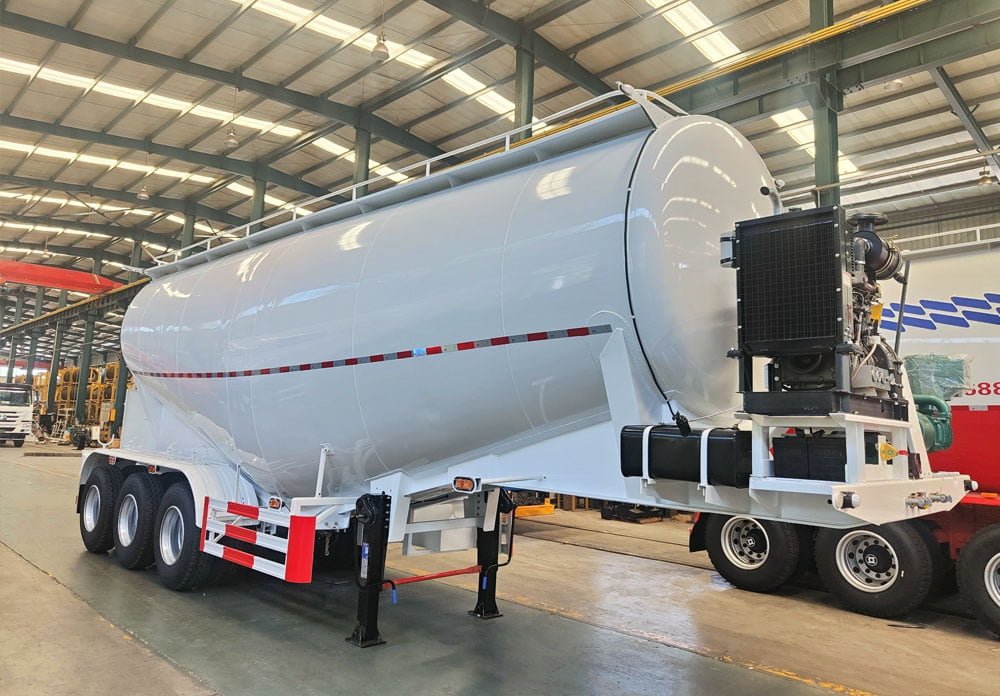
The W-type cement tank can carry different kinds of materials. It can transport powdery and granular materials with poor fluidity, such as flour, ultra-fine fly ash, heavy soda ash, feed, urea, soda ash, silica powder, casting sand, titanium dioxide, granite aggregates, etc. It can also transport weakly adhesive and weakly adsorbable granular materials, such as soybeans, wheat, corn, PA66, PVC, PTA, BPA, PP, PC, and coarse grain fly ash.

Although the W-type tank can carry more, its price is higher than that of the common V-type tank. If you only need to carry cement powder, the V-type is a cost-saving option.
Key Components of Bulk Cement Tank Trailers
Tank Structure and Material
The tank structure of a bulk cement tank trailer is V-shaped and W-shaped. Depending on specific requirements, the material used for cement tank trailers can be carbon steel, aluminum alloy, or stainless steel. The cost-effective carbon steel tank trailer is enough if the tank is only used for cement powder. If the tank is used for transporting wheat flour, you should choose aluminum alloy or stainless steel materials to protect the flour from contamination.
Engine: The Powerhouse
The engine is the power source of the trailer’s unloading system. The trailer usually has an independent diesel engine to drive the air compressor. The compressed air produced by the compressor (or the externally connected compressed air) enters the air chamber inside the tank body, and the materials are transported to the specified location outside the tank along the unloading pipeline with the air.
Chinese cement tank trailers are mainly equipped with Weichai or German Deutz engines. The Weichai engine is stable in performance and affordable, making it the first choice for most customers. However, customers can consider Germany’s Deutz if they pursue higher-quality engines.
Discharge System
The discharge system of a bulk cement bulker is a critical component for efficient unloading, consisting of air compressors (blower systems), valves, and pipes. Chinese cement tank trailers are currently equipped with Bohai brand swing-type compressors, with exhaust volumes of 12 cubic meters or 14 cubic meters.
Some customers also choose screw-type air compressors, which are light in weight, have large displacements, and can work continuously for long periods. However, screw air compressors are expensive, so most customers choose swing-type air compressors because of their stable performance and better price.
Chassis: The Support System
Like our body’s skeleton, the chassis is the skeleton of the trailer, made of high-quality steel, providing the necessary support and durability to withstand heavy loads and rough terrain.
Chassis Dissection
The chassis comprises several interconnected components, including the main beam (frame), axle, suspension, tires, and brake system.
Axle: The Load Bearers
The axle bears the load of the vehicle and cargo. The number of axles may vary depending on the size of the tank trailer and its load capacity.
Usually, cement tank trailers with less than 50 cubic meters tank volumes choose 3 axles. However, some customers’ local regulations require 50-cubic-meter cement tank trailers to use 4 axles. Therefore, you also need to comply with your local regulations when selecting the number and bearing capacity of the axles.
The load capacity of the axle mainly includes 13 tons, 16 tons, 20 tons, and 25 tons axles. Famous axle brands include Guangdong Fuwa Axle from China, BPW Axle from Germany, L1 Axle, ZY Axle, Yuke Axle, etc. In the same grade, a BPW axle is usually about 25,000 RMB more expensive than a Guangdong Fuwa axle, and a Fuwa axle is about 1500-2000 RMB more expensive than a small factory axle. When selecting, be aware of counterfeit BPW and Fuhua axles; you can verify their authenticity via the security labels or by contacting the axle manufacturers.
Suspension: Shock Absorption
The suspension is another key component of the chassis. Its primary role is to absorb shocks and vibrations from the road, reducing the impact of rugged terrain on the tank and the overall vehicle.
Generally, most customers choose mechanical leaf spring suspension for their bulk cement tank trailer, because it is robust, affordable, and easy to maintain.
Some customers may choose air suspension, which greatly absorbs shocks and vibrations from the road, offering a smoother ride and good shock absorption to protect the goods and prolong the service life of the trailer. However, the price of air suspension is higher than spring suspension. Hence, most customers currently choose leaf spring suspension or a combination of leaf and air suspensions.
Tires: Supporting Load
The tires bear the weight of the semi-trailer and its cargo, absorb bumps, and reduce road vibrations. Tires are mainly divided into tubeless tires and tube tires.
Currently, most customers prefer tubeless tires because they are cheaper than steel wire tires and lighter in weight, reducing the vehicle’s weight and saving fuel. Furthermore, even if a tubeless tire gets punctured, it won’t blow out immediately, avoiding an immediate impact on the customer’s transport task. Customers can wait until the end of their transport task to repair the tire.
Famous tire brands include Triangle, Double Coin, Chaoyang, and Chengshan. Common tubeless tire types include 12R22.5, 13R22.5, 315/80R22.5, and 385/65R22.5. Tube tires include 12.00R20, 12.00R24, or 11.00R20.
Braking System: Ensuring Safety
A reliable braking system is important for safe transportation. If your budget allows, I’d suggest that your bulk cement tank trailer be equipped with WABCO emergency valves, ABS anti-lock brakes, and dual air chambers. These can greatly improve the vehicle’s braking performance, ensuring transport safety.
Furthermore, if you select a 13-ton axle, request 16-ton brake pads, which will improve the braking effect of the axle.
Landing Gear
The landing gear is a support leg that supports the trailer when it detaches from the tractor truck. Please don’t just focus on the ton for the landing gear. Some suppliers only show the bearing capacity of the landing gear on their specification sheet, knowing the price varies by brand.
There are many well-known brands in China, like Guangdong Fuwa, JOST, and Zhenjiang Baohua. Fuwa landing gear costs about 2500 RMB, while other common brands cost about 1000-1500 RMB.
Manufacturer Features: Different Brand Features
Different brands take different approaches to designing and manufacturing bulk cement tank trailers. Some focus on robustness and durability, while others focus on economic efficiency (also known as cost-effectiveness). Some brands have more advanced designs. When selecting your bulk cement tank trailer, you should make thorough comparisons.
Summary
At the start, learning about bulk cement tank trailers can feel tricky. However, with some basic knowledge and details, it becomes much easier to understand these big trailers. Now, thanks to my simple guide, ‘Understanding Your Bulk Cement Tank Trailer,’ when you get info from suppliers, you can understand what it means and how to choose the best bulk cement tank trailer for your needs, just like a pro.
Sometimes, it is not enough to compare the product specifications; you also need to ask suppliers to provide you with more information, such as product explanation videos, customer feedback cases, or even visit suppliers’ factories.
Frequently Asked Questions (FAQs)
Q: Can bulk cement tank trailers transport other materials?
A: Bulk cement tank trailers are primarily designed for transporting cement and other cementitious materials. Using them to transport other materials unsuited for their design specifications can lead to safety hazards and damage to the trailer. It is crucial to adhere to manufacturer guidelines and specific legal requirements regarding the materials transported.
Q: How often should a bulk cement tank trailer be inspected?
A: Bulk cement tank trailers should be inspected regularly to ensure optimal performance and safety. The frequency of inspections can vary based on factors such as usage intensity, distance traveled, and environmental conditions. However, a general guideline is to conduct a comprehensive inspection at least once every three months, with additional visual inspections before and after each use.
Q: What licenses or permits are required to operate a bulk cement tank trailer?
A: The required licenses and permits for operating a bulk cement tank trailer may vary depending on local regulations. In most jurisdictions, a commercial driver’s license (CDL) is required, along with any specific endorsements or


